


Insurance for dentists
When it comes to insurance, we don't want you to simply go with the flow. Which is why at Guild, we're constantly evolving to reflect the real-life needs of dentists like you.
Join Guild Insurance today and choose to be protected by an insurer that's worked hand in hand with ADA NSW, ADAVB, ADA SA and ADATAS for over 25 years.

Professional indemnity and liability
Protects you for what you do as a dentist.

Business
insurance
Protects your dental practice and items in it.
Professional indemnity insurance covers you for your civil liability when a claim arises from a breach of your professional duty. Many professional policies at Guild Insurance combine professional indemnity, public liability, and product liability to cover more of your professional duties. Business insurance, on the other hand, is a broader category that encompasses various types of coverage designed to protect businesses from a wide range of risks. This can include property damage, theft, and liability claims from third parties.
For professionals providing advice or services:
- Assess your service risk: Evaluate the potential risks associated with your professional advice or services. Consider the possibility and implications of your advice or actions leading to a client's physical, psychological, or financial detriment. Reflect on the likelihood and consequences of a situation where an error or omission on your part could lead to legal action.
- Understand legal requirements: Familiarise yourself with the legal and regulatory landscape relevant to your profession. Is holding professional indemnity insurance a legal requirement or an industry standard in your field? For certain contract positions and many allied health professionals regulated under Ahpra, professional indemnity and/or public liability insurance is required.
- Consider your financial exposure: If faced with a legal claim, could you afford the legal defence and potential damages out of pocket?
For business owners protecting their operations:
- Identify your business assets: Determine which physical assets are crucial to your business operations, such as property, equipment, and inventory. Consider the consequences if these assets were damaged, stolen or lost.
- Evaluate liability risks: How likely is it that someone could be injured or their property damaged because of your business activities? This includes both public liability and product liability.
- Consider business interruptions: Think about the resilience of your business in the face of unforeseen events that might force temporary closure. How would such interruptions impact your financial stability?
If you are unsure of the cover you require, please contact us on 1800 810 213 to speak to an insurance specialist.


Key product features
Discover the limits and coverage built in to every Guild dentist liabilities policy.
Renewal FAQs
See the latest frequently asked questions and information for renewals in 2026.
Association endorsed
Find out more about our long standing partnership with several branches of the ADA.
Hear from other dentists
01/09/2024
 The support and guidance is very good. They helped me through it with patience.
01/07/2024
Simple and comprehensive. I wouldn’t choose anyone else for insurance.
01/01/2025
I have compared you with few other insurances but yet to find a good company like Guild!

Working with over 130 associations

Insuring Australians for over 60 years

100% Australian owned
Learn how Dentists avoid claims with RiskHQ
Are you sure your professional indemnity insurance is current?
While making your way through emails one evening, you come across one from Ahpra (Australian Health Practitioner Regulation Agency). It informs you that they’ve received a notification about you from one of your patients, alleging your treatment has caused harm. You’re shocked and confused; this has never happened to you before. You immediately notify Guild Insurance, knowing they’re there to support you during moments like this. However, the situation becomes more concerning when Guild informs you that your policy lapsed five months earlier.
Could this happen to you? It’s easy to think not. However, Guild Insurance has noticed a worrying trend of practitioners failing to maintain instalment payments during the policy period, or to renew their policy.
Ahpra’s registration standards
Being covered by a professional indemnity insurance (PII) policy is a registration standard for all health professionals registered with Ahpra. This means that every practitioner must be covered by either their own PII policy or a third party arrangement. Section 129 of the Health Practitioner Regulation National Law states that:
“A registered health practitioner must not practise the health profession in which the practitioner is registered unless appropriate professional indemnity insurance arrangements are in force in relation to the practitioner’s practice of the profession.”
Section 130 of the National law details relevant events where, if they occur, a practitioner is required to notify their relevant Board within seven days after becoming aware of the event. PII arrangements no longer being in place is one of these events.
It’s recommended that all practitioners review their Board’s Professional Indemnity Insurance Registration Standard which can be found on the Ahpra website: www.ahpra.gov.au.
Implications of having no PII
No cover for an investigation or complaint
Most PII policies provide cover on a claims-made basis. This means that, regardless of when the alleged event occurs, if the practitioner doesn’t have a policy at the time they become aware of the complaint, they won’t be covered for that claim. Without a PII policy, the practitioner won’t have the support of a claims manager or lawyer, instead having to respond to the claim or complaint themselves, or pay a lawyer to do this for them. By not having a PII policy, this would also mean the practitioner has to self-fund any compensation payable to the patient, which can be quite costly.
Breach of professional requirements
As already mentioned, not being covered by a PII policy is a breach of Ahpra’s registration standards. Further to this, it can lead to practitioners making a false declaration at the time of registration renewal. At renewal, practitioners are asked to declare that they won’t practice without PII. If they continue practicing when there’s no longer a PII policy in place, this may mean they’ve made a false declaration. There are possible registration consequences for practicing without PII. This can include conditions placed on the registration, refusal of an application for registration renewal or suspension of registration.
What can be done to prevent this?
The team at Guild do all they can to make customers aware when their policy is due for renewal, or if the policy is going to be lapsed or cancelled due to non-payment of the premium. However, ultimately, the responsibility for maintaining PII cover sits with each individual practitioner.
PolicyHub – Guild Insurance has an online self-service platform called PolicyHub where customers can access their insurance information. If you aren’t sure when you last paid your insurance premiums and you want to check when it’s due, logging onto PolicyHub is an easy way to keep yourself informed. This can be accessed via Guild’s website – guildinsurance.com.au/policyhub.
Reliance on a third party – if a practitioner doesn’t hold their own PII policy and is instead covered by a third party’s policy (e.g. your employer’s), this doesn’t mean the practitioner isn’t responsible for ensuring they’re appropriately covered. Practitioners should discuss the policy with the third party to ensure, first and foremost, that they have a policy, but also that the level of cover is appropriate for the practitioner’s requirements.
Set reminders – a common explanation for not maintaining insurance is that the practitioner has a poorly-managed inbox and doesn’t stay up-to-date with reading emails, meaning some are missed. If this might happen to you, think about how else you can be sure you won’t miss that renewal date. Setting a reminder in a calendar is one simple way to do this.
Setting a reminder in your calendar is one simple way to help not miss your insurance renewal.
Don’t go it alone
guildinsurance.com.au
- Acupuncture
- Chiropractors
- Dental Prosthetists
- Dentists
- Natural Therapists
- Nurses
- Occupational Therapists
- Optometrists
- Osteopaths
- Paramedics
- Pharmacists
- Pharmacy
- Physiotherapists
- Podiatrists
- Professional
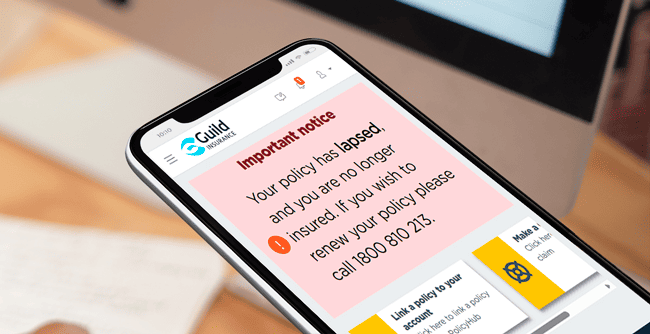
Login to PolicyHub for all your policy needs
- All-In-One Dashboard: Manage all your policies and documents in one place.
- Easy Updates: Quickly update personal and business details online.
- Enhanced Security: Protect your account with multi-factor authentication.
- Document Access: Instantly access policy documents and tax invoices.
- Claim Management: View current and past claims effortlessly.
- Flexible Payments: Update billing details.
- Policy Renewal & Reinstatement: Renew or reinstate policies with ease directly through PolicyHub.
- Certificates of Currency: Obtain proof of insurance with just a few clicks.

FAQs
The law governs that any professional exercise the required skill to an appropriate level expected by that profession. A professional may be liable for financial loss, injury or damage arising from an act, error or omission of fault if the professional has not acted to the required level of skill deemed in that profession. Failure through this may result in the claimant (person who suffered the loss) be awarded for that loss, damage or injury.
Many professions require you to hold a professional indemnity insurance policy by law, such as Ahpra registered professions, but can be for other industries such as financial institutions also. Please check with your registration body or associations of your profession to know if it is required by law to have professional indemnity insurance. It is often also required by companies who take on contract workers that are not governed under the companies own insurance policy. It is acceptable for a company to ask you as the professional contractor to provide evidence of cover for professional indemnity before starting the contract period.
As stated above professional indemnity insurance covers you for breaches in relation to your professional duty. Liability insurance covers you for activity that results in personal injury or property damage as a result of your business activities that do not relate to your specific profession. An example may be someone who trips and is injured from spilled water within your office may be covered under liability, because it is your duty of care as business person to provide a safe environment. Whereas a person who suffers a loss or injury because of your professional treatment in relation to your job has caused it would usually be consider as an indemnity breach.
Generally business insurance is to cover the physical assets of your business for material damage loss and options for theft cover. It can also include cover for financial loss due to business interruption. Usually basic insurance does not cover breach of duty or flood cover, but if you speak to an insurance specialist it can often be added to your policy for a nominal fee.
Depending on the policy you are taking out, covers will often vary. At Guild insurance we specialise in making a policy to suit your business so that you are not over paying for covers you wouldn't normally need. The best thing to do is call 1800 810 213 to speak to an insurance specialist, they can find out what activities and structure your business is in to then provide you with adequate cover for you.
A certificate of currency (or COC for short) is a written document that confirms that your insurance policy is current and valid at a specific date and time. At Guild we provide easy access to your COC at any time within a few clicks of our online portal PolicyHub. If you are a new customer we can provide you with one post purchase.


Write a review Average rating: